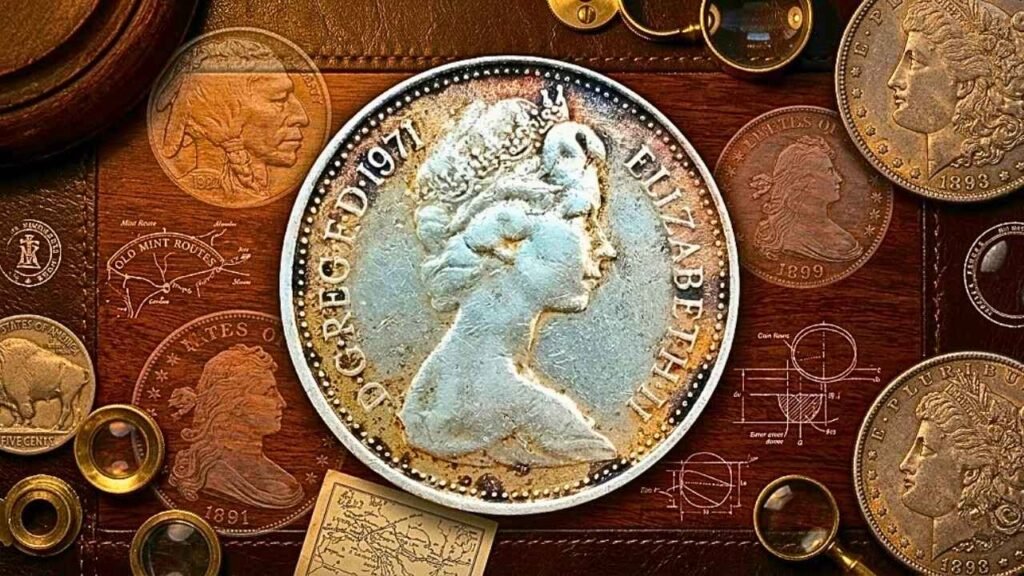
The United Kingdom introduced decimal coinage in 1971, marking a major change in its monetary system. Among the coins released was the 5 New Pence, featuring Queen Elizabeth II on the obverse. While most examples remain common, certain rare varieties and conditions have made the 1971 Elizabeth II 5 New Pence coin a subject of fascination for collectors. This guide explores its history, design, rarity, and potential value in today’s market.
The Decimalisation of 1971
Before 1971, Britain used a system based on pounds, shillings, and pence. Decimalisation simplified the currency, making it easier to use and understand. The 5 New Pence coin was introduced as part of this change, replacing the older shilling. It was equal in value to one shilling, but carried a modern design suited to the new system. This transition marked a turning point in British coinage history.

Design and Features
The 1971 5 New Pence coin features the portrait of Queen Elizabeth II on the obverse, designed by Arnold Machin. The reverse shows a crowned thistle, symbolising Scotland, designed by Christopher Ironside. Struck in cupronickel, the coin was durable and practical for circulation. Its design reflected both tradition and modernity, making it a fitting symbol for the new decimal era.
Circulation and Minting
Millions of 5 New Pence coins were minted in 1971, making them widely available. Most circulated heavily, and many remain in collections or as keepsakes from the decimalisation period. However, not all coins are equal in value. Certain proof issues, error coins, and coins in exceptional condition stand out as rare and valuable.
Proof and Collector Issues
The Royal Mint produced special proof sets in 1971 to commemorate decimalisation. These sets included pristine examples of the 5 New Pence coin, struck with extra care to ensure sharp details and mirror‑like finishes. Proof coins are far rarer than circulation strikes, and collectors prize them for their quality. A proof 1971 5 New Pence in perfect condition can command significant premiums compared to ordinary examples.
Error Coins and Rarity
Error coins add another layer of intrigue. Mistakes during minting, such as off‑center strikes, double strikes, or planchet flaws, create unique coins that collectors eagerly pursue. While error 5 New Pence coins from 1971 are not common, they can be worth far more than face value. Their rarity and uniqueness make them highly desirable among enthusiasts.

Condition and Grading
As with all coins, condition plays a major role in determining value. Coins that have circulated heavily may only be worth face value, while uncirculated or proof examples can be worth much more. Professional grading services assess coins based on wear, luster, and strike quality. A high‑grade 1971 5 New Pence can attract strong interest from collectors, especially if it is part of a complete decimalisation set.
Market Value and Demand
The market for 1971 5 New Pence coins remains steady, with collectors interested in both historical significance and rarity. Common circulation strikes are generally worth little more than face value, but proof coins and rare errors can sell for much higher amounts. Online auctions, coin shows, and dealer inventories often feature these coins, with prices reflecting condition and demand. For collectors, the 1971 5 New Pence represents both a piece of history and a potential investment.
Tips for Collectors
For those interested in collecting the 1971 5 New Pence, focus on proof issues and error varieties. Learn to recognise authentic coins and avoid counterfeits. Purchasing from reputable dealers and certified auctions ensures quality. Building a collection that includes the 1971 5 New Pence alongside other decimalisation coins can be both rewarding and educational, offering insight into a pivotal moment in British monetary history.
Key Highlights
- The 1971 5 New Pence coin was introduced during UK decimalisation
- Features Queen Elizabeth II portrait by Arnold Machin and crowned thistle by Christopher Ironside
- Millions minted, but proof and error coins are far rarer and more valuable
- Condition and grading play a major role in determining value
- Proof coins and rare errors can command significant premiums
- Collectors prize the coin for its historical significance and rarity
Final Words
The 1971 Elizabeth II 5 New Pence coin is more than just a piece of currency; it is a symbol of change in British history. While most examples remain common, rare varieties and proof issues have transformed some into valuable treasures. For collectors, the coin offers both historical significance and financial potential. Whether kept as a nostalgic reminder of decimalisation or pursued as a rare collectible, the 1971 5 New Pence continues to capture the interest of enthusiasts across the world.